Sunday, June 18, 2023

Leviticus as Literature

A footnote in Robert Alter’s masterful translation of the Hebrew Bible referenced what I saw as an unlikely title: Leviticus as Literature, by the British anthropologist Mary Douglas. I have thought about Leviticus as many things over the years – a book of laws and regulations, a guide to proper living as a Jew (at least an ancient one), the source of much of the repellant weaponization of the Bible that we are forced to deal with in today’s society – but literature would not have been one of the ways I would have characterized the third book of the Torah. 

 Coming after the stirring narratives of Genesis and the first half of Exodus, the second half of Exodus and Leviticus together are like stumbling blocks put in the way of enjoyment of the Bible. Exodus’s long, detailed instructions on construction of every detailed aspect of the Tabernacle at least captured the part of my attention that has always drawn me to architecture and woodworking. I have sometimes wanted to try to follow these instructions to see what would result. But Leviticus has been a book I have had to force myself to slog through; I recognized its importance in the history of the Jewish people, but have found little in its repetitive instructions for animal sacrifice and priestly ritual, or its strictures regarding sexual behavior and other human interactions, to hold my attention. It has seemed the most ancient of books, and the least relevant to modern life. So this unexpected title intrigued me. 

 When I read -- especially when I read the Bible -- I follow trails of footnotes as a detective might follow clues in solving a mystery. One reference often leads me to another, and pretty soon I have accumulated a reading list that I may or may not be inclined to tackle. This footnote sent me straight to Amazon, where I found this 1999 title available as a Kindle book. 

Thus I got my hands on a book that has had a greater impact on my reading of the Bible than any since John Shelby Spong’s The Fourth Gospel a decade ago. 

Douglas approaches Leviticus as a cultural artifact rather than as a holy object. She situates it in its time and place – the Middle East, probably at the end of the Babylonian exile, when the author we refer to as the Priestly writer was active. (The Priestly writer also is credited with the first creation story, In Genesis chapter 1). Douglas expends much effort in contrasting Leviticus with Deuteronomy, which she sees as a work of rational, scientific, modern thought. Leviticus, by contrast, operates by analogy, a more ancient form of understanding than science. Although she briefly addresses the question of which writer was earlier – the Priestly writer or the Deuteronomist – she knows that would be an endless debate and instead focuses on the difference in perspective. 

The fundamental analogy she sees at work in Leviticus is the structure of concentric circles, which are applied to Mount Sinai, to the Tabernacle and to the animal body. The innermost circle in all of these, in her analysis, is the dwelling place of God: The peak of the mountain (think of it as the center if looking down from above), the “Holy of Holies” in the Tabernacle, and the guts – the reproductive organs and the intestines – in the body. The latter may be difficult for us to comprehend. Douglas explains:

“Bashfulness apart, it is important to ask why the innards should be at the point of highest esteem, the position that corresponds to the holy of holies, instead of the face or head or heat to which we accord more honour. The question calls for difficult comparative psychography, but at least recall that there has always been in the Jewish culture a strong association between body and tabernacle in respect of fertility. 

“The Bible locates the emotions and thought in the innermost parts of the body; the loins are wrung with remorse or grief; the innermost part is scrutinized by God; compassion resides in the bowels … The temple was associated with the creation, and the creation with fertility, which implies that the innermost part of the tabernacle was a divine nuptial chamber. Even from complete ignorance of mysticism, the analogy of the inner sanctuary with the centre of creation is intelligible. It was fitting that the sanctuary was interpreted as depicting in a most tangible form the union between God and Israel.” 

This central idea, the association of the tabernacle with “creation and … ‘abounding fruitfulness’,” should inform our reading of the entire book of Leviticus, Douglas contends. 

“Deuteronomy distances God, he does not abide in the tabernacle, only his Name and the glory of it are present, whereas Leviticus and Numbers believe God to be present, close to his people at all times, and meeting with them in the tent of meeting.” 

One mistake we make, Douglas says, is to view Leviticus as a laundry list of rules and regulations and not as an overall composition: 

“Leviticus has been read in an itemized way, items of law corresponding to elements of morality, or to elements of narrative, or to elements of hygiene, but not to their place in an integral composition.” 

For today’s readers, familiar with modern astronomy, the theory of concentric circles may bring to mind our understanding of the solar system, which after all of an interconnected systems of concentric circles in rotation and revolution. 

Douglas extends the analogy linking Mount Sanai to the Tabernacle to the body to the book of Leviticus itself, comparing its first seven chapters, which focus on sacrifice, to the forecourt of the Tabernacle, where the entire community could gather and where the sacrificial rites took place. The next three chapters comprise a narrative leading up to God’s killing of Aaron’s sons Nadab and Abihu for a vaguely defined offense having to do with bringing “alien fire” toward His altar. Douglas sees these chapters as an analog to the screen that separates the forecourt of the Tabernacle from its interior, the sanctuary, which can be inhabited only by the priestly caste. 

Douglas's diagram of Leviticus superimposed on the plan of the Tabernacle

Although these chapters bring us to the first screen, Douglas contends that the next 6 chapters, which give us the series of law, regulations and strictures regarding food; bodily emissions, including both sexual fluids and blood; and diseases of the skin, continue a circuit around the forecourt. Chapter 16 provides detailed instructions for the preparation that Aaron must make before entering the sacred space where the ark presides. And in chapter 17, we get a more explicit prohibition on the slaughter of animals in any context except sacrifice, as well as the rationale for the high degree of concern – she calls it squeamishness -- over blood. From Leviticus chapter 17: 

“The life of the flesh is in the blood … for it is the blood that ransoms in exchange for life. Therefore, have I said to the Israelites: no living person among you shall consume blood, nor shall the sojourner who sojourns in your midst consume blood.” 

With chapter 18 and its delineation of prohibited sexual practices, we move into the sanctuary, where we stay through the middle of chapter 24. In these chapters we learn, among other things, about righteous living, first for the people and then for the priestly caste; the importance of using only “unblemished” livestock in the sacrifice as well as the importance of human cleanliness in these situations; and the holy calendar. 

In chapter 24, we get the second piece of storytelling in Leviticus, the story of the man who curses God and is stoned by the people. Douglas sees this as analogous to the second screen, the one that separates the interior of the Tabernacle from the Holy of Holies, where the Ark of the Covenant resides, and where only the high priest may enter, on only the holiest of occasions. Finally in chapters 25-27, we are in the Holy of Holies, where we learn about the Jubilee to be celebrated every 50 years, when debts are forgiven, slaves are freed, and the world is “reset” to one of equality for humanity. 

Unlike the narrative books of the Bible, which are grounded in time, Leviticus is grounded in space. Reading it as a whole, we move deeper into the Tabernacle until we reach its most holy space. The importance of the narrative components as screen is that they serve as barriers to the next chamber. In Douglas’s words: “They are warning clear enough against sacrilegious approach.” 

Given the climactic importance of the Jubilee, it may strike us as odd that instead of this celebration and return to equality lasting through history, it has been abandoned while the strictures on sexual behaviors have been so thoroughly weaponized that they have informed public policy in many places. By carefully reading and digesting Leviticus, one might get the idea that the “radical socialists” have it right, while the tsk-tsking church ladies and gentlemen are focused on less serious matters. Oh, well. That’s human nature for you. 

Like many commentators, Douglas identifies chapters 18-20 as the “heart” of the book, with the two chapters identifying sexual offenses and their penalties framing a chapter on righteous living. Here is what Douglas has to say about that structure: 

“There could not be a stronger framing of the central chapter at the apex of the pediment. Leviticus’ scheme very deliberately puts the laws of righteous and honest dealings at the centre and the sexual sins at the periphery. Less a pedimental composition, these two chapers are more like two massively carved pillars on either side of a shrine, or like a proscenium arch.” 

Noting that this structure is introduced by a passage cautioning that, “You shall not do as they do in the land of Egypt, where you dwelt, and you shall not do as they do in the land of Canaan, to which I am bringing you,” Douglas sees the entire structure as one leading away from the idolatrous Egyptian and Canaanite cultures, which indeed were known for incest, in the case of Egypt, and temple prostitution, both heterosexual and homosexual, in the case of Canaan. Douglas summarizes it this way: “These chapters contrast the pure and noble character of the Hebrew God with the libidinous customs of the very strange false gods.” 

Douglas’s innovative and insightful reading of Leviticus gives us new perspective on many of the familiar prohibitions, but perhaps none is more startling than her take on animal life. Connecting Leviticus back to Genesis, she reminds us that God created all of the creatures, and pronounced there that all of his creations were “good.” Keeping that in mind, she argues that conventional readings misinterpret many of the words and practices detailed throughout Leviticus. 

She urges us, for example, to disassociate the emotions of disgust and revulsion from the term “unclean,” which she argues is a technical term related to inappropriateness for the temple, applied to menstruating women and men who have had wet dreams as well as to certain animals. Again, she notes differences between the ways Leviticus and Deuteronomy use words such as “unclean,” “impure,” and “abomination,” this last of which she sees as applying (in Leviticus) to the act of consumption rather than to the animal under discussion. 

Douglas’s take on prohibition grows most interesting when she discusses the “swarming” creatures whose consumption is prohibited. These she sees as prolific breeders exemplifying God’s command to be fruitful and multiply. She also notes that many of these have few natural defenses, so that the prohibition on killing and eating them may be a way of protecting them and allowing them to thrive. 

On the other hand, she is pretty much mystified about the ban on consumption of pork – arguably the most famous and widely heeded food proscription, detailing a variety of hypotheses without really coming to a satisfactory explanation. 

While connecting the practice of sacrifice itself to the milieu of the ancient Middle East where sacrifice was endemic, she contends that sacrifice is a moment at the border between life and death where the animal is both killed and honored. The details of the butchering and the order of placement on the sacrificial altar is critically analogous to the three levels of Mount Sinai and the Tabernacle. The ban on killing and consumption of land animals outside the sacrificial setting – an important distinction from Deuteronomy – is testament to the reverence for the life of God’s creations. 


In a fresh take on the ritual of the scapegoat, described in chapter 16, Douglas points out that while conventional readings suggest that the scapegoat is sent out into a fearsome wilderness where it will surely become prey and suffer an awful death, Leviticus itself makes no such prediction. It simply says that the scapegoat is sent away; it does not at all suggest a fate, positive or negative. It is God’s creature, not punished but set free, released into God’s wilderness, just as its partner, the sacrificial goat, is turned to smoke – which Douglas sees as transformation rather than destruction – allowing it to rise to God. 

This essay could go on and on, becoming like Lewis Carroll’s ever more detailed map that ends up recreating the landscape it sets out to describe. To avoid that, I’ll stop here. I’ll save Douglas’s insights on skin and penetration (both sexual and not) for another time. But in resting, I hope that I have provided a reason for others to open this remarkable book and develop and understanding that moves beyond the widespread weaponization of some of its messages.

Saturday, June 3, 2023

Banning the Bible

It has finally happened. In a season of frenzied book bannings, a Utah school district has banned the Bible as inappropriate reading for elementary and junior high school students. In its decision, the David School District cited “vulgarity or violence.” According to The Salt Lake Tribune, a parent had asked for review of the “sex-ridden” book last December, on the basis that the Bible contains, “incest, onanism, bestiality, prostitution, genital mutilation, fellatio, dildos, rape and even infanticide … You’ll no doubt find that the Bible, under Utah Code Ann. 76-10-1227, has ‘no serious values for minors’ because it’s pornographic by our new definition.” 

As ironically humorous as we may find the situation, it is appalling that children in the district’s 59 elementary schools and 17 junior high schools will not have access to the western world’s greatest work of literary art. Knowledge of the Bible is not simply a matter of religion. It is a vital key to understanding the visual arts, literature, music, and drama. 

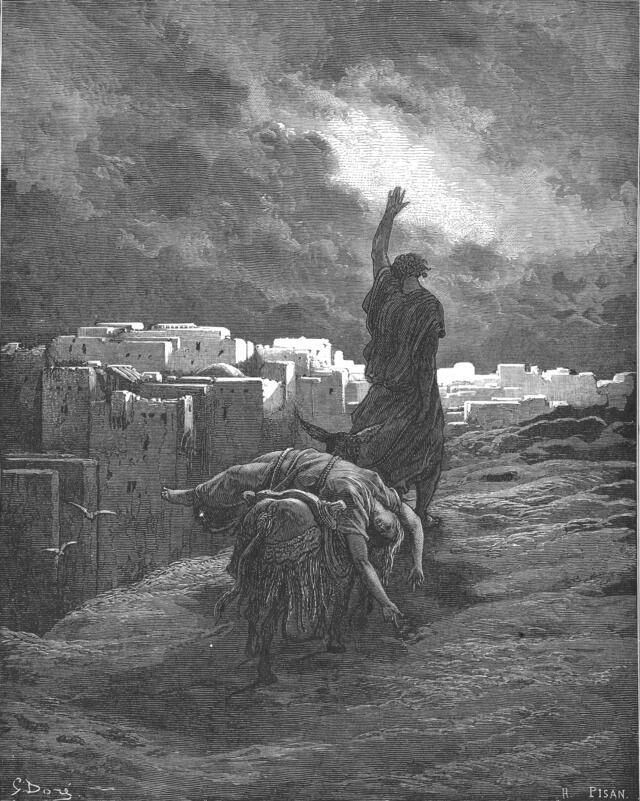
It’s also important to acknowledge the truth in the parent’s contention. The Bible has some of the most horrifying stories of sexual violence ever put on paper. The story of the Gibean concubine in Judges gets my vote for the most terrible, but the Biblical narrative also includes the rapes of Jacob’s daughter Dinah and David’s daughter Tamar, the rape and forced child-bearing of Abram and Sarai’s slave Hagar, the decision by Lot’s daughters to get their father drunk and have sex with him, the human sacrifice of Jephthah’s daughter (also in Judges).
Gustave Dore: The Levite Carries the Woman's Body Away

Even some of the comic episodes, such as the story of the Mandrake root involving the sister-wives Leah and Rachel, and the theft of Laban’s household gods, which Rachel hides by placing them under the pillow on which she is seated and then claiming that she is menstruating, are sexually charged.

March Chagall: Rachel Hides Her Father's Household Gods

These are not the stories we hear about in Sunday school – and I am willing to bet that many cafeteria “Christians” are unfamiliar with them -- yet they are critical pieces in the extraordinary tapestry of the Bible. Yet it is undeniable that, coupled with Leviticus’ detailed inventory of proscribed sexual practices, these Biblical stories could expose a child to a a thorough, if eccentric, education in sexual practices and mores. That’s not surprising. 

If there is a predominant theme in the Hebrew Bible -- what Christians call the Old Testament – it is God’s command in Chapter 1 of Genesis to, “Be fruitful and multiply, and replenish the earth and subdue it.” God forms covenants with Adam and Eve, Noah, Abraham and Sarah, and Moses in all of which He promises enormous fertility in return for faith and good behavior. It would be far too simplistic to characterize the Abrahamic religions as fertility cults, yet fertility is never far from the center in the Biblical narrative. The complainant in Utah is not wrong in contending that the Bible is "sex-ridden."

To quote the anthropologist Mary Douglas, writing of Leviticus's many regulations about sexual matters:
"Religions which ritualize sex are usually more in favour of it than against. To suppose that the numerous sexual regulations of Leviticus exhibit a narrowly puritanical attitude to sex would be like expecting a culture with numerous food rules to condemn good food. It is where sex is recognized as a potent elemental force, at once the source of desire, fulfillment, and danger, that religion seeks to appropriate sex and to bind it with rules."
So what’s the answer for a school district concerned with protecting children from sexually charged material? Well, one good answer would certainly be to be less obsessed with children being exposed to material with sexual content. The Utah case is a perfect illustration on how that obsession can (and should) backfire. Another would be to understand that children ask questions honestly when they encounter new ideas. Hiding things from them and/or lying about their meaning is never a good idea. Honest discussion in the classroom with a well-informed, caring teacher could help to undo the damage that ill-informed and prejudiced parents and clerics can inflict.

The Bible ban in Utah's second-largest school district is in a Mormon community, but lest anyone feel comforted by that, it should be noted that another parent has challenged the Book of Mormon (the sacred text, not the musical) in Utah schools.

In my opinion, what is lost in banning the Bible -- and many other important works of art and literature --  far outweighs any the challenge of answering uncomfortable questions a child might ask.

While I don’t believe that public education should ever embrace a single religious doctrine (or sexual orientation), I believe that we owe our children exposure to the world of ideas, and that emphatically includes religion. I believe in teaching religion in public schools in the same spirit that we teach literature: Examine important ideas that run through human culture, and look at the different ways that religious traditions deal with them. 

Allowing children to explore, especially a work as central to western culture as the Bible, gives students a license to inquire, something many parents seem to be afraid of, but which should be encouraged in any society.

We might actually end up with a generation of students less ignorant about religion, sexuality and other sensitive subjects than are today’s leaders.


Saturday, April 8, 2023

The Chosen

When I sat down, belatedly, to watch the crowd-funded biblical series “The Chosen,” I hoped to find it as entertainingly ridiculous as I find most Bible-based dramatizations. But while it certainly has a few cringeworthy moments comparable to Hollywood classics like “The Greatest Story Ever Told,” I have mostly found it to be thoughtful and absorbing. Most biblicaldramatizations seem to me to be at least a little infused with faith (the primary exception being Mel Gibson’s homoerotic S&M fantasy, “The Passion of the Christ”, which has maybe 15 seconds of inspirational content). 

This series is thoroughly immersed in faith, and yet is far less self-righteous than most biblical entertainments. The writers are not only familiar with the storylines of the Gospels, but are confident enough in their faith to allow questions and interpretation. 

 The episodic, series format gives the Gospel stories breathing room that allows for development of context around the scriptures. This is not merely a rushed, two- or three-hour tour, but an extended contemplation of the meaning behind the narratives . And perhaps because of the expansive format, now in its third season, Jesus comes across much differently here than in the many movies, and even in Franco Zeffirelli’s mini-series “Jesus of Nazareth”, that also have drawn their plotlines from the Gospels. 

 One of the problems with portrayals of Jesus is that He never seems quite human – although many of us have learned that He is both fully human and fully God, that doesn’t seem to be the case in when He is portrayed as a sad, stoically suffering sphynx. Whether portrayed by Max Von Sydow, or Jeffrey Hunter, or Jim Caviezel, Jesus has always been a man without a personality. By contrast, the Jesus of “The Chosen” actually talks to people and listens to what they have to say, gets angry, smiles and laughs. At one point he tells a "too soon?" joke. He clearly enjoys His ability to bring joy into the lives of the beneficiaries of His blessings. The only comparable portrayal I have seen is the impatient, short-tempered Jesus played by Chris Sarandon in the long-forgotten (although not by me) TV movie, "The Day Christ Died." In that take on the Passion, Sarandon played Jesus much as he is depicted in the Gospel of Mark, I think.Granted, we haven’t gotten yet to the Passion story, in "The Chosen," but I’m going to predict an eventual, fresh take even on that most overtold climax. 

 Also unlike most dramatic portrayals, the apostles are shown here as having distinctive personalities, and given back stories that help to explain their willingness to follow this nonconformist hero. Peter’s relationship with his wife, here called Eden, is explored; Matthew is depicted as an autistic man whose condition gives him the mathematical abilities that have made him a successful tax collector. We see Matthew at his work, wheeling and deadling with his Roman overlords, in a way that gives real color to the scene where Jesus defends His association with those shunned by Jewish society (it is not the healthy who need healing but the sick). 

The first season of "The Chosen" ends with the story of the Samaritan woman at the well, from the Gospel of John. The second season begins with John conducting interviews to document Jesus' life for what will become his Gospel; that episode ends with a lovely scene that marries the opening of Genesis with the opening of John; two magnificent texts brought together in a logical and heartfelt way. Although episodes unique to John are prominent in the series -- the wedding at Cana, the nighttime visit from Nicodemus -- all four Gospels figure into the episodes. The series format gives space, I think, for the stories to be woven together more gracefully than in movies that rush to give a complete depiction of the events of Jesus's life. The second-season opening, for example, while elaborating on the backstory of the Samaritan woman, takes time to provide context for Luke's parable of the Good Samaritan.

 There is a lot more that could be said about this series, but I think it is better for me to recommend it to anyone interested in the Gospels. Enjoy it for yourselves, and most of all, think about the depictions of the characters and the stories as they are portrayed here.

I was convinced to check out this series after reading the opening paragraphs of a New York Times interview by Tish Harrison Warren with Jonathan Roumie, the actor who plays Jesus. Unlike Warren, I love Biblical dramatizations, but mostly because I so often find them ridiculous -- white men in frayed robes speaking an uneasy English meant to simulate, I suppose, Biblical language. But on many points I am in complete agreement with her. Having been duly impressed, I was inspired to revive this ten-years-dormant blog. I salute Tish Harrison Warren for providing this inspiration; if I have at times hewed too closely to her words, I apologize. The intent was not to plagiarize but to spread the good news.

Monday, September 2, 2013

A Couple of Johns

One of the pleasures resulting from an obsession with the Bible is the opportunity to read some of the superb writing about the Bible that is produced every year. This summer, for example, we have seen a very good book about Jesus, Reza Aslan’s Zealot:The Life and Times of Jesus of Nazareth, climb to the top of the best-seller lists. But more importantly for me, it has seen the publication of a remarkable new study of the Gospel of John, John Shelby Spong’s The Fourth Gospel: Tales of a Jewish Mystic.


The Fourth Gospel was my introduction to the writings and perspective of Rev. Spong, the long-time Episcopal bishop of Newark, now retired. But following my discovery of this refreshingly down-to-earth cleric and scholar, I have been voraciously devouring his works. The Fourth Gospel is his 23rd published book, and I look forward to reading them all, because this one has altered my perspective in  way that few written works ever have.


John can be a troubling gospel for those of us who question the supernatural content of the Bible. For us, it can be relatively easy to read the other three gospels, called collectively the synoptics, for their philosophical wisdom, focusing on the brief, pithy, parables and beatitudes as evidence of Jesus’ incomparably beautiful philosophy, and to gloss over the recounting of miracles as so much filigree added unnecessarily to embellish His brilliant teachings. But the gospel of John is a different animal; it is distinguished by what is called its “high Christology,” its insistence on the godly and timeless nature of Jesus, characterized as the “only begotten son” of God. There are no parables in John, and few brief statements of wisdom. Instead we get that gorgeous prologue, a poem of unsurpassed beauty, followed by a narrative of Jesus’ ministry that focuses on seven “signs”, in turn followed by several lengthy chapters of monologue known as the “farewell discourses,” and finally the passion, crucifixion and resurrection. Much of what is told in John is told only in John, and the telling has an altogether different feel than do the other three narratives (which are called synoptic because they view Jesus “with the same eye”).
Over the past 2000 years, John seems to have been the loudest voice inviting us to worship Jesus rather than to learn from him. And as one who views Jesus primarily as a teacher, a “rabbi”, who meant for his words to be listened to rather than his life fetishized, I sometimes found John’s gospel a little bit hard to take.

The new John in my consciousness, Rev. Spong, has blessedly corrected my view. Indeed, Spong says, he had to correct his own view of the gospel, which he had often found “repellent,” due to the creeds and dogmatic thinking and abuses done ‘in the name of the Lord’ for which he blamed John.
“Because this book was thought to have spelled out ‘orthodox Christianity,’ John’s gospel also helped to fuel such dreadful events in Christian history as heresy hunts and the Inquisition. As the centuries rolled by, John’s gospel seemed to make meaningful discourse on the nature of the Christ figure almost impossible.”
He goes on to say:
“Throughout most of my career, both as a priest and as a bishop, I saw John’s gospel more as a problem in ministry than as an asset. So my tactic was to avoid it, if possible, to ignore it whenever I could not avoid it, and simply to resign myself to the reality that it was in the canon of scripture. Sometimes I walked around this gospel. At other times I attacked it or at least attacked those I thought misunderstood and/or misused its message. I certainly never wanted to spend much time on it.”
The change in his thinking came about, Spong says, when he began to view the fourth gospel as a Jewish book and to examine its connections to Jewish experience, Jewish history and, especially, Jewish mysticism. He describes his journey in some detail, but the climax is this:
“I began to rethink and ultimately to dismiss the theistic definition of God and started moving away from an understanding of God as ‘a being’ to an understanding of God as ‘Being itself,’ or as Paul Tillich, the formative theologian of my early training, would say, as ‘the Ground of Being’ … John’s gospel began to unfold before me as a work of Jewish mysticism and the Jesus of John’s gospel suddenly became not a visitor from another realm., but a person in whom a new God consciousness had emerged. Now, seen from that new perspective, the claim of oneness with the Father was not incarnational language, but mystical language.”
And, because I can’t keep myself from quoting this amazing volume that has resulted from Spong’s years of study:
“John’s gospel is about life – expanded life, abundant life, and ultimately eternal life – but not in the typical manner that these words have been understood religiously.”
From what I have gleaned so far in his writings, Spong has built his notable career on an effort to free Christianity from a literalism that he believes imposes first-century thinking on contemporary life, to no good end. A heaven that is above the sky and disease caused by demons are not concepts we can tolerate in the face of today’s science, but a literal reading of the Bible – an atrocious insistence that the words and events of the gospels are “literally true” – demands that we accept what we know to be nonsense.

Thus, it is no surprise that his new approach takes on the issue of literalism. One of the most striking aspects of The Fourth Gospel is Spong’s illumination of the many passages in this gospel that speak directly to this issue, and which ridicule or dismiss the notion that its words should be taken literally. For example, when Jesus tells the Pharisee Nicodemus, who in chapter 3 has come to visit him in the dark of night, that, “Unless you are born from above, you cannot see the kingdom of God,” Nicodemus’ response is a comically literal reading of Jesus’ words:
“How can one be born when one is old? he asked. “One cannot enter a mother’s womb a second time and be born.”
In the next chapter, the Samaritan woman at the well reacts in a similar manner to Jesus’ statement that,” Whoever drinks the water I give them will not be thirsty again. The water I give them will become in them a fountain of water springing into eternal life.” Taking His words literally, the Samaritan woman sees the “living water” as a great labor-saving innovation:
“Sir, give me this water so that I won’t be thirsty or have to come here to draw it up.”
Once Spong has pointed it out, it’s clear from these passages that those who apply literal meaning to the words given to Jesus by John are meant to be seen as foolish, misguided. The Samaritan woman, whose visit with Jesus happens in the light of day, comes to understand what Jesus meant and goes on to convert her townspeople, while Nicodemus chooses to retreat back into the darkness from which he briefly emerged (and from which he will make additional brief appearances).

So, if we aren’t meant to take this gospel as literal history, what does it mean? Does it have any meaning for us? Oh yes, Spong says. The meaning derives from Jewish mystical tradition. The magnificent prologue to this gospel, which I consider to be among the most beautiful words ever written, is often said to reflect Greek thinking, but Spong argues that this tone-setting poem reflects instead a deep understanding of Jewish spirituality. The prologue is shaped, of course, by reference to Genesis 1, the priestly creation story in which God creates the world entirely with words. Since this gospel, like all of the others, appears to have been written in Greek, the word “logos” has been given primary importance, and with it all of the connotations in Greek thought and Greek usage that come with it. But Spong urges us to look at the Hebrew word for word, “dabar,” and to understand that, “The Hebrew concept of dabar indicated that this ‘word’ had power to shape the world, to reveal the presence of God, to call people to a heightened sense of selfhood, a heightened consciousness.”

And so it makes great sense for John to say that, ”What came to be in the word was life, And the life was the light of the people.”

The equation, then, of the word to life and to light and to Jesus tells us that Jesus brought the light of life to the people he encountered, that in fact his mission was to bring this light in the form of a new consciousness that allows us to experience life fully, abundantly, gloriously.

The wedding at Cana, a story specific and unique to John’s gospel, takes on a new cast in this new light. A wedding marks the beginning of new life, the life of a new family. This wedding takes place significantly on the “third day,” a reference that may seem mysterious because we have just been told about three preceding days, which would make this at least the fourth. But again, don’t take the reference literally. The third day is, as we know from all of the gospels as well as from Paul, the day of resurrection, the day when new life is given to something or someone that has died. So we can understand this a symbolic setting, one that is about the moment of new life, a reading which may help to explain why in this wedding story we are told nothing of the bride and groom or why Jesus, his mother and the disciples have all traveled to attend.

We see that the wedding has run out of wine. The old wine is gone. After his mother’s urging, Jesus directs the servants to a set of six large jugs meant to hold water for ritual use. But the jugs are empty. Not only is the old wine gone, the ritual water is gone. Jesus tells the servants to fill the jugs with water (the jugs are said to hold two or three measures, an amount equivalent to 20 or 30 gallons each) and then to dip from them and take the liquid to the master of the celebration, who congratulates the bridegroom effusively on his brilliance in serving a superior wine late in the celebration. The new wine, brought on by Jesus, is a superior wine as well as a transformation of old, empty ritual into new life. Jesus, we are being told, is bringing new life to replace old, tired traditions and rituals that have lost their meaning.

I’m going to end this post here, because I know I will write about the Rev. Spong and his wonderful books again soon. And I can’t tell this story with anything like his brilliance.

Read The Fourth Gospel. Buy it, borrow it, steal it if you have to. But read it.

Saturday, August 25, 2012

The Bible I Love

The Bible is the greatest achievement of western culture. I say that without a touch of irony, because I believe it – if I have a reservation, it is only about whether ancient Israel should be considered “western.” But I’ll move past that reservation because the Bible is foundational to the west. It is the bedrock upon which our art, literature, music and philosophy rest. Our world would be unrecognizably different were it not for the Bible.


The wonder of the Bible is in its vastness, its complexity, its vivid narratives, its passionate polemic and its gentle expressions of love. An anthology – some would say an anthology of anthologies – spanning more than 1,000 years of the greatest writing of the ancient Middle East, the Bible takes us from the beginning of the world to its end. It’s hard to be more comprehensive than that.

The Bible is endlessly enjoyable, filled with familiar stories that form the background of our lives and less familiar ones that may shock people who think they know what’s within its covers. It is both high art and lowdown, raucous entertainment.

It is important, I think, that it be appreciated as art. The many authors of this text were adults writing for adult audiences. They wrote complex texts that can support a multitude of readings; they are meant to be studied, torn apart, argued over. They span a wide variety of styles – prose and poetry, fable and fairy tale, domestic and wartime drama, thoughtful and probing essays, warnings and celebrations.

The Bible is many, many things. What it is not is a factual history or a science textbook – and it is the insistence that it fill these roles that leads to the intolerance and demagoguery that is too often associated with those who claim to live by “the Book.” I would argue that taking the Bible literally as either history or science is in fact an insult to its authors, a manifestation of deep disrespect for their achievements as artists.

Yes, the Bible is meant to teach us, but not in this literal fashion. Various portions of the Bible – in particular the Gospels – are in fact quite direct in pointing to the parable as their preferred form of storytelling. It’s not just the stories Jesus told directly that should be understood as parables.

I’ve spent most of the past year teaching about the story I consider to be the heart of the Bible – the David narrative in the books of Samuel . In my view, everything that comes before David in the Bible looks forward to his reign, and everything after looks back. Seen in this light, the stories of the patriarchs, of the exodus, and especially the tales of the judges all are told to prefigure the coming of David, whose kingdom represents the height of earthly power for the sons and daughters of Israel. Afterward, beginning with the reign of his son Solomon, things begin to fall apart and nothing that subsequent rulers, prophets and military leaders can do will restore the glory of the time of David.

It is, of course, a story that has strong parallels to the much later legend of Arthur. But the David story as told in Samuel (and the first few chapters of I Kings) is more complex, more believable and more memorable than that of Arthur (which I also love, but which has to yield ground to the David narrative). David combines domestic drama -- his many wives; the betrayal that allows his marriage to Bathsheba; the rape of his daughter Tamar by her half-brother Amnon; the revolt led by his son Absalom – with the military exploits of David and Saul, and the religious narrative focusing on the life of the prophet Samuel, the anointing of Saul and David, and the subsequent prophecies of Nathan.

The storytelling in Samuel is vivid, the detail is stunning. Although there is no undisputed archaeological evidence of the united, prosperous kingdom of the Jews described in these texts, the power of the narrative is so strong that I tend to believe there was a real David, and that his story – a prime example of a “warts and all” biography – was written down close to the time of his life. Although a popular theory holds that Samuel is part of what is called the Deuteronomistic history, composed or compiled after the Babylonian exile, I suspect that the David story was an existing narrative that was edited and woven into the larger narrative cycle.

That doesn’t mean I believe the David story is accurate history, just that there is a core of truth on which the story is built, much in the manner of a historical novel.The author of Samuel shaped the David story as a work of art, designed for impact. We are meant to see -- and we do see -- David as Messiah, as the pinnacle of Israelite history and culture. We are meant to understand that his unwavering faith in Yahweh places him there, despite his otherwise very human failings.

Chronicles retells the David story without the warts. It's still a majestic story, but it doesn't have the immediacy or the impact of Samuel. It's respectful and respectable -- as the Samuel telling manifestly is not. Chronicles contains no hint of the betrayal of Uriah, for example. We don’t hear about Saul’s gradual descent into madness, leading to his deadly pursuit of David through the wildernesses of the Holy Land. When David’s first wife, Michal, the daughter of Saul, watches the procession that brings the Ark of the Covenant into Jerusalem, Chronicles dutifully repeats the Samuel author’s observation that while watching David dance ecstatically she “despised him in her heart,” but leaves out the compelling detail that a good part of the reason for her displeasure was that while David was dancing, his short ephod flipped up, exposing his genitals to the view of everyone in town.

It’s details like that that make the David story so absorbing. Like all great literary art, the David story transports us into its world and crowds out doubt. By itself, it would be a staggering achievement. That it is one of so many powerful stories in the collection that is the Bible, makes its existence all the more astonishing.

Saturday, September 24, 2011

"Am I My Brother's Keeper?"

It’s the first question asked by a human in the Bible, and one of the most resonant questions of all time. God is a veritable question box in the early chapters of Genesis (he seems far from omniscient in these stories), and the serpent famously asks Eve a challenging question about her allowed diet. But not until Cain defensively poses this question to God has a human made an inquiry of any sort.
God’s response to Cain comes in the form of banishment for the murder of Abel. The answer is essentially that if you don’t consider yourself the protector of your sibling, you can no longer be considered part of the family. However, Cain’s sentence is tempered not only by the mark of protection he places on him but the opportunity to create his own family and to understand the protective relationship from a different perspective. Where that wife of his came from is never answered, but Cain does become a husband and father. God teaches Cain a lesson, but one that gives him the opportunity for redemption, for a new life in a different setting.
And the sibling relationship becomes one of the great themes of the Bible. It is explored over and over again both in the literal sense – in the stories of Jacob and Esau, Joseph and his brothers, Abimelech and his 69 brothers, Amnon and Absalom, Adonijah and Solomon, and others – and in a broader sense through the fact that all of the nations with against which Israel goes to war are shown to come from a common ancestry, generally well documented. Not until we hit the Romans in the New Testament does a culture seem truly alien (the story of Rome’s integration into the family is post-biblical but certainly no less stunning than the Bible’s stories of familial/cultural relationships).
Many have noted that throughout the Bible, it is the younger son – usually one perceived as physically weaker – who receives God’s favor. Certainly the nation of Israel is perpetually portrayed as weaker than its enemies but stronger in its relationship to God (in the story of Gideon, for example, the Israelite army is forced through a selection process into a position of physical weakness over which it prevails).
As the stories of warring siblings and warring nations unfold, a related topic is brought into play: Our responsibility to care for the weakest and most vulnerable members of society. “Widows and orphans” is the shorthand most often used.
Here is God laying down the law to Moses in Exodus 22: “You shall not afflict any widow or orphan. If you afflict them in any way and they cry out to Me, I will surely hear their cry; and My wrath will become hot, and I will kill you with the sword; you wives shall be widows and your children orphans.”
In Deuteronomy, Moses repeats and elaborates on the requirement, insisting that the Israelites have an obligation to feed not only widows and orphans, but resident aliens and the homeless (the Levites, descendants of Israel who were not given a portion of the Holy Land). In addition, debts are to be forgiven every seven years, and failure to honor this obligation is considered a serious offense:
If there is among you a poor man of your brethren within any of the cities in your land the Lord your God is giving you, you shall not harden your heart, nor shut your hand from your poor brother; but you shall surely open your hands to him and willingly lend him sufficient for his need, whatever he needs. Beware lest there be a hidden thought in your heart, a transgression of the law, saying, ‘The seventh year, the year of remission is at hand,’ and your eye be evil against your poor brother, and you give him nothing, and he cry out to the Lord against you, and it be a great sin among you. You shall surely give him and loan him as much as he needs, and your heart should not be grieved when you give to him, because for this thing the Lord your God will bless you in all your works and in everything to which you put your hand. For the poor will never cease from the land; therefore, I commdn you to do this word which says, ‘You shall surely open your hands to your brother, to your poor and needy in your land.’

In Job, Eliphaz the Temanite poetically speculates that failure to care for the needy is one of Job’s sins (although we certainly can’t be sure about the veracity of Job’s supposed friends): 


For you have taken pledges from your brethren for no reason

And taken away the clothing of the naked.

Neither have you given the thirsty water to drink,

But have even withheld a morsel from the hungry.

You have also admired the personality of some

And have transplanted those already settled on earth.

Your have sent widows away empty

And have have mistreated orphans.

Therefore snares are all around you,

And a serious war has troubled you.

The light has turned to darkness for you,

And water has covered you as you fell asleep.

In Psalm 68, David calls God “the father of orphans and the judge of widows,” and in Psalm 82 we are told to, “Defend the poor and fatherless; do justice to the afflicted and needy. Deliver the poor and needy; rid them out of the hand of the wicked.”
In all, we are instructed more than 40 times in the course of the Bible to care for those who are least able to care for themselves: The widows, orphans, resident aliens and homeless who live among us. Because “widows and orphans” is the shorthand most often used, some may be tempted to identify them as a special class, but the inclusion at key times of resident aliens and the homeless Levites should make it clear that what the Bible is talking about are the most needy and vulnerable among us.

Given that this message of familial responsibility toward all of humanity is so explicit and so often repeated, it has been more than a little disturbing in the past few weeks to hear people in the audience at political debates here in the United States cheer for the idea of letting an uninsured 30-year-old die if he has no insurance, whoop at the notion that Social Security is a “Ponzi scheme,”  and boo at the thought of respectful treatment  for a homosexual soldier defending this country in a theater of war. That these reactions came from political factions that loudly self-identify as Christians makes the behavior even more disturbing.
While I try not to make this blog too overtly political, neither my political beliefs nor my moral ones are ever far from me. And when behavior like this erupts at political events, I often wonder whether these supposed believers use the Bible as anything more than a hard surface upon which to thump.

There are many topics upon which the Bible is internally contradictory. But the obligation to care for the neediest in society is not one of these. David, Isaiah, Jeremiah, Zechariah, Malachi, James and many of its other authors repeat the message and reinforce it. And lest anyone try to argue that the Bible extends this charity only toward like believers, get over it. The Bible argues that we are all of common descent; charity is extended without requirement of a test of belief.
“All men are brothers” may be viewed by some as a trite and sentimental statement, but the Bible is quite clear in laying out the idea (through its descriptions of the genesis of nations and societies) and even more clear about our obligations toward each other.

I’ll end with the simple words of the prophet Isaiah: "Learn to do good. Seek Judgment and redeem the wronged. Defend the orphan and justify the widow."


Saturday, August 27, 2011

They Shall Have Dominion ...

The day after a magnitude 5.9 earthquake struck the east coast of the United States, I read this thoughtful article by Rabbi Edward Bernstein of Temple Torah in Boynton Beach, Florida. So, as thoughts all over the east coast turned from the earthquake to an approaching hurricane, my own thoughts, as usual, turned to the Bible.
I had some help. That the Washington, D.C., area was facing a one-two punch of natural disasters had set the political blogosphere and the Facebook populace afire. There were prophecies of doom and of impending salvation based on readings of biblical passages. There were jokes about the founding fathers turning over in their graves because of the sins of the right or the left; there were attempts to label the earthquake fault line “Obama’s fault” or “Bush’s fault”; there was Pat Robertson making his usual pronouncements about the events being signs from God. I got into the act with an observation that the epicenter of the quake was in Rep. Eric Cantor’s district and thus was a Tea Party phenomenon; it was fun for a day or so.

But when I read Rabbi Bernstein’s article, I began to reflect more seriously on humanity’s impact on the Earth. Now anyone who has read this blog knows that I am in no way a believer in the Bible as literal truth. It’s certainly not anything approaching literal history or science. I don’t believe in an anthropomorphic God and have no use for the idea that He sends down specific earthly judgments.
But I do believe in providence. And I believe that the Bible supports the idea of providence. I’m also a believer in a concept of universal law and justice that is not wholly based on biblical teaching but is in part expressed through the teachings of Jesus, Paul, James, Isaiah, Jeremiah and other biblical figures. All those ancient Middle Eastern philosophers were on to something big, in my opinion.

The Sh’ma – the topic of Rabbi Bernstein’s piece – is one place in which the Bible gives us a poetic portrait of humanity’s responsibility for the “behavior” of the Earth. The paragraphs on which Bernstein focuses read (in the translation available online in the JewishVirtual Library:

And it shall come to pass, if ye shall hearken diligently unto My commandments which I command you this day, to love HaShem your G-d, and to serve Him with all your heart and with all your soul, that I will give the rain of your land in its season, the former rain and the latter rain, that thou mayest gather in thy corn, and thy wine, and thine oil. And I will give grass in thy fields for thy cattle, and thou shalt eat and be satisfied. Take heed to yourselves, lest your heart be deceived, and ye turn aside, and serve other gods, and worship them; and the anger of HaShem be kindled against you, and He shut up the heaven, so that there shall be no rain, and the ground shall not yield her fruit; and ye perish quickly from off the good land which HaShem giveth you. Therefore shall ye lay up these My words in your heart and in your soul; and ye shall bind them for a sign upon your hand, and they shall be for frontlets between your eyes. And ye shall teach them your children, talking of them, when thou sittest in thy house, and when thou walkest by the way, and when thou liest down, and when thou risest up. And thou shalt write them upon the door-posts of thy house, and upon thy gates; that your days may be multiplied, and the days of your children, upon the land which HaShem swore unto your fathers to give them, as the days of the heavens above the earth.

(HaShem, literally “The Name,” is a Hebrew term for God that Jews often use as a way of referring to Yahweh while avoiding other names that are limited to ritual use).

This passage -- part of Moses’ grand valedictory address to the Israelites who are approaching the Holy Land after 40 years in the wilderness – suggests a direct relationship between the Israelites’ behavior and weather events in the Holy Land. We may reject that one-to-one correspondence – I do – and yet, as Bernstein points out, find in it a broader truth: That humanity’s behavior toward the Earth does have an impact on the Earth’s “behavior” toward humanity.
To explore that, we might go back to Genesis 1:26, in which God, having created humanity in His image, gives our species a level of control over the rest of creation:

And G-d blessed them; and G-d said unto them: 'Be fruitful, and multiply, and replenish the earth, and subdue it; and have dominion over the fish of the sea, and over the fowl of the air, and over every living thing that creepeth upon the earth'.

This passage was famously cited a few years ago by the political provocateur Ann Coulter (I’m never sure how to refer to Coulter, but provocateur seems as good a term as any) in an anti-environmental rant:
God gave us the earth. We have dominion over the plants, the animals, the trees. God said, 'Earth is yours. Take it. Rape it. It's yours.’
Giving Coulter the benefit of a great degree of doubt, I will assume this was one of her typical attempts to start a fire by exaggerating a position. But it’s a particularly feeble one, even for her. Coulter is representative of a small, vocal minority that rejects environmental science, using a misrepresentation of scripture to support right wing political/economic ends. I’m pretty sure there’s no implication in Genesis that we should rape the Earth.

Indeed, we are told to replenish the Earth, a command that I think is best read broadly. Although it is coupled with the instruction to “be fruitful and multiply,” I would argue that the injunction to “replenish the Earth” is not limited to promoting the survival of humanity. And while “dominion” is a term implying rule – it shares an etymological root with “dominate” and “domain” – I don’t think it in any way suggests reckless rule.

I share with a lot of religious people a belief that when God placed his creation in our hands, he did so in the sense that we should care for it and protect it as something holy, something to be revered. And in this sense, taking responsibility for human behaviors that have exacerbated global warming is entirely consistent with the Bible.
It’s important to point out that Genesis 1 is attributed by most biblical scholars to the Priestly source, a person or group of writers who worked during the post-exilic period, around 500 B.C., a time when the Jews, recently allowed to return to the Holy Land from forced exile in Babylonia, were rebuilding their cities and places of worship, in particular the Temple in Jerusalem. The God depicted by the Priestly source is one who values law and order; this source is also deemed responsible for Leviticus and the portions of Numbers that are concerned with laws of human behavior.

The Sh’ma, the passage of Deuteronomy cited earlier, is attributed, in contrast, to the Deuteronomist, who is also believed to be the author(s) of the books of Joshua, Judges, Samuel and Kings. This author, who wrote in the years prior to the conquest and exile, was focused on telling the story of the founding of the Jewish nation.
And the second creation story, in Genesis 2, is attributed to the Yahwist source, or J, who wrote something very different, a narrative focused on humanity in which God plays an important role but human behavior is really in control of events. It is through J’s narrative that we learn about Adam, Eve and the serpent; Abram and Sarai’s wanderings; the complex family dynamic of the patriarchs and matriarchs, and Moses’ leadership of the Israelites out of Egypt and through the wilderness.

I know that many people reject this standard scholarship and believe that the  Torah was handed down by God to Moses in its current form (notwithstanding the fact that there is no universal agreement on that current form). For those who hold to this belief, there is a compelling sequence in the events of Genesis 1 and Genesis 2-3, culminating in the Fall of humanity.
After Adam and Eve eat the forbidden fruit, the whole concept of dominion over the Earth seems to fly out the door. Instead of being overlods, we are told, humanity will be at the mercy of the Earth. The angry God, after condemning the serpent to wander on its belly and Eve to endure labor pains, passes sentence on Adam:

And unto Adam He said: 'Because thou hast hearkened unto the voice of thy wife, and hast eaten of the tree, of which I commanded thee, saying: Thou shalt not eat of it; cursed is the ground for thy sake; in toil shalt thou eat of it all the days of thy life.Thorns also and thistles shall it bring forth to thee; and thou shalt eat the herb of the field. In the sweat of thy face shalt thou eat bread, till thou return unto the ground; for out of it wast thou taken; for dust thou art, and unto dust shalt thou return.'

We’re no longer above the rest of creation. We came from the Earth and we will return to be part of the greater whole upon our deaths. Disrespect for the environment – the Earth – is disrespect for ourselves, for our roots and for our destination.